 Shining Pages
How to improve your child's handwriting: 7 simple ways
By Shining Pages · Updated 14 November 2026
If your child is in Class 1 to 3 and the teacher keeps writing "improve handwriting", more pages of copying will not help much. Handwriting has four parts: shape, size, line and spacing. Fix them in that order, a little every day.
1. Fix the pencil grip first
A fist grip or a four-finger grip tires the hand and makes letters shaky. Teach the three-finger grip: the thumb and first finger pinch the pencil, and it rests on the middle finger, about one finger-width above the sharpened part.
Quick trick: lay the pencil on the table with the point towards your child. They pinch it near the point and flip it back over the hand.
2. Check sitting and paper position
Feet flat on the floor or a stool, back straight, both arms on the table. A right-handed child tilts the top of the page a little to the left; a left-handed child tilts it to the right. The other hand holds the paper still.
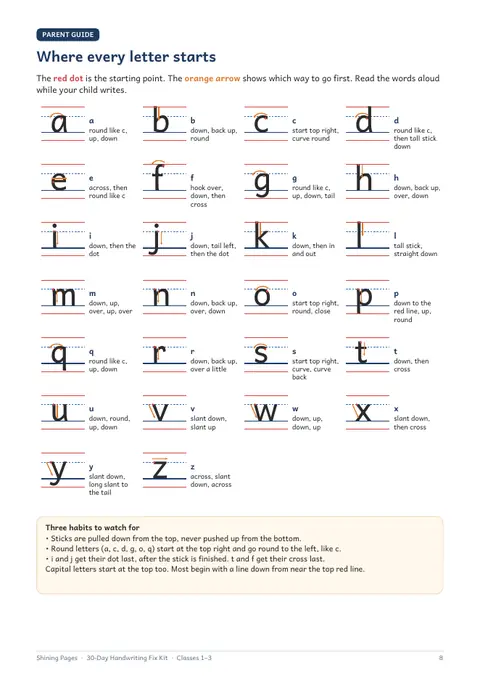
3. Teach where each letter starts
Many children draw letters from the bottom up, which makes them slow and uneven. Two rules cover most letters:
- Sticks are pulled down from the top, never pushed up.
- Round letters (a, c, d, g, o, q) start at the top right and curve to the left, like the letter c.
4. Show the three letter sizes
On a four-line notebook, small letters (a, c, e, m, n) stay between the two blue lines. Tall letters (b, d, h, k, l) reach the top red line. Tail letters (g, j, p, q, y) go down to the bottom red line. Tell it as a house: the room, the upstairs and the basement.
5. Make every letter sit on the line
Floating letters are the most common reason a page looks untidy. After each line, ask your child to tick the letters that touch the bottom blue line. Children enjoy checking their own work, and they start to notice the line while writing.
6. Use a finger space between words
Ask your child to place a finger, or an ice-cream stick, after each word before starting the next one. Spacing is the fastest change a teacher will notice.
7. Keep practice to 15 minutes, and praise first
Long sessions end in tears. Use the same time and place each day: 2 minutes of warm-up strokes, 10 minutes of practice, and 3 minutes for your child to circle their best line.
Replace "write properly" with something specific: "Show me your best 'a' on this line." Praise one thing before you correct one thing, and correct only one thing per session.
When to ask for more help
Speak to your child's teacher or paediatrician if your child has pain while writing, cannot copy simple shapes, still reverses many letters after age 7, or also finds reading and spelling very hard.
Want all of this as a ready 30-day plan?
The 30-Day Handwriting Fix Kit turns these seven steps into daily printable pages for Class 1–3, with a 2-minute test to find your child's main problem.